The butterfly flew from one lawn to the next looking for food, but all there was only grass with nothing else. Finally, she found some low growing flowering sedges. There were other butterflies as well as bees here, too, and a bit farther off, a child played fetch with a dog. Lawns are one of the most common sights and for a groundcover or a place to kick a ball around, they have their uses. However, most traditional turf grasses aren’t native to North America, are frequently invasive, and require a large amount of care. Nevertheless, there are a large number of native grasses which provide important habitat for a large variety of species, generally require less mowing and no fertilizer, and still be a place for people as well.
Grasses:
Pennsylvania Sedge (Carex pennsylvania)
This grass reaches about 9 inches tall, requires well drained dry soil, and tolerates shade. It stops growing by early summer and generally only needs to be mowed once to twice a year to stay 4-5 inches. It is native to New York and Maine south to Virginia, the Carolinas, and Tennessee, and west to Washington, California, and New Mexico.
Plantain sedge (Carex plantaginea)
This grass grows to 12 inches, needs moist soil, and shade to partial shade. It has bright green leaves and small yellow flowers in early spring. It is native to New Brunswick and southern Quebec to southern Indiana, Kentucky, New Jersey, Maryland, and northern Georgia.
Poverty oat grass (Danthonia spicata)
This grass reaches 8-16 inches and also only needs mowing once to twice a year. It is native to most of the United States and needs well drained or seasonally moist soils and full sun, though it will tolerate dry and nutrient poor soils. Flattened oat grass (Danthonia compressa) is native to the eastern U.S. and California oat grass (Danthonia Californica) is native west of the Rockies.
Groundcovers:
Common strawberry (Fragaria virginiana)
Strawberries grow 3 to 6 inches, have small white flowers in May and fruit in June. They are native throughout North America. After fruiting they send out runners, and so spread easily and are an excellent groundcover. They attract bees, butterflies, and birds (and, of course, people too!)
Moss phlox (Phlox subulata)
This flower grows 2 to 6 inches tall, needs well drained soil and has pink flowers from April to May. It is native to southern New York to southern Michigan and south to North Carolina and Tennessee.
“Traditional” lawns are essentially a monoculture and provide little in the way of biodiversity. Nevertheless, there are larger spaces where grasses and groundcovers are the best option for that particular area. For such places, native grasses and groundcovers can provide both food, nesting, and overwintering sites as well as a green place for people, pets, and pollinators.
As always, not using pesticides or fertilizers is also important in creating habitat for birds, bees, and butterflies. For other resources, go to plant finder on the National Wildlife Federation (www.nwf.org), put in your zip code and the site will provide a list of all plants native to your area. For my other articles on wildlife gardening, including plants for small spaces, shade tolerant plants, and food plants for both people and wildlife see April 2019, May 2020, May 2021, July 2022, June 2023, and June 2024.
The butterfly flitted between the buildings looking for flowers. But here, where there were so many buildings, there wasn’t much sun and not much grew. The butterfly landed on the wall of one of the buildings to rest and around the corner she spied a yard with asters and echinacea, which didn’t mind the shade. The butterfly alighted on one of the asters and drank the sweet nectar. With increased urbanization, many species of birds, butterflies and bees have far fewer sources of food and nesting sites and several are facing population declines as a result. However, planting flowers and shrubs which can provide needed food and cover for many of these species as well as adding color to the yard. Whether it’s buildings or a lot of trees gardening in shaded areas can be a challenge. Nonetheless, there are a variety of flowers shrubs, and trees which can tolerate shade and, in some case, event prefer it. The following are some of the plants which are shade tolerant as well as being important plants for wildlife.
Part Shade: These plants can tolerate shade, so long as they get some sun for part of the day.
White wood Aster (Aster divaricatus)
These flowers are hardy to zones 3-8, prefer moist soil, produce white flowers from July to October and are very tolerant of shade. They are native to New Hampshire, southwest Quebec, southern Ontario to southern Ohio, northern Georgia, and eastern Alabama. Two similar species include the blude heart leaved aster (Aster cordifolius), which has blue-violet flowers from June to November and the big leaved aster (Aster macrophyllis), which grows 1-2 feet and blooms from September to October.
Purple coneflower (Echinacea purpurea)
This flower is hardy to zones 3-9, prefers moist soil, grows from 26-36 inches, and flowers from June to October. It is native to southern Michigan, Ilinois, Iowa, eastern Oklahoma, and south to northeastern Texas and Geogia. It attracts many species of butterflies and its seeds are also good for birds in the fall. In addition, its leaves can be made into a tea which is good for sore throats and congestion.
Bee balm (Monarda didyma)
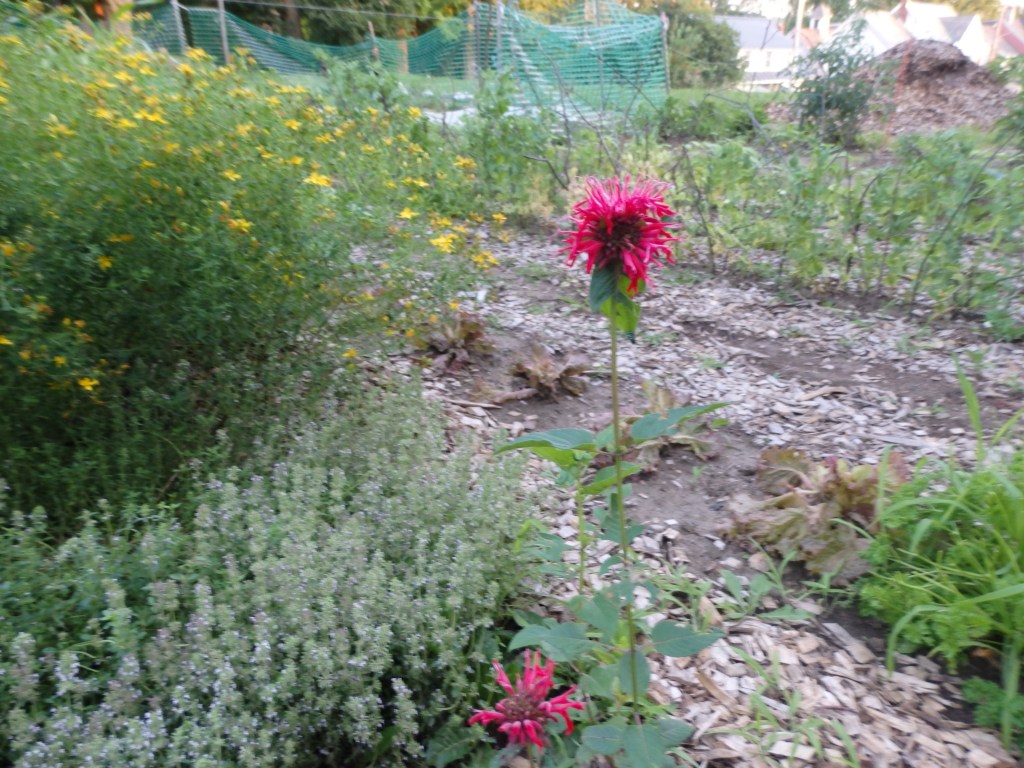
This flower is hardy to zones 3-9, prefers moist soil, grows 36-48, and produces beautiful red flowers in July. It is native to Maine and Michigan south to West Virginia, Ohio, and northern Georgia. It lives up to its name and is one of the best for bees and is also popular with hummingbirds. Its leaves can also be made into a tea and was a Native American remedy for sore throats.
Wild blue phlox (phlox divaricata)
This flower is hardy to zones 3-9, prefers moist soil, grows 12-14 inches, and produces violet or lavender blue flowers in the spring. It is native to northwestern Vermont, Quebec, and Minnesota south to Georgia and Texas.
Creeping phlox (Phlox stonifera)
This plant is hardy to zones 4-9, prefers moist soil, grows 6-10 inches tall and produce blue lavender or white flowers. It is native to the Appalachian region, Pennsylvania, Ohio, and Georgia.
Spicebush (Lindera bezoin)
This shrub is hardy to zones 4-9, prefers moist soil and can grow up to 10 feet. It has clusters of yellow flowers from March to April, red fruit in summer, and has bronze to yellow leaves in autumn. It is native to Maine and Michigan and south to Florida and Texas. It is an important larval food source for the spicebush swallowtail.
Cinnamon clethra (Clethra acuminata)
This shrub is hardy to zones 5-8, prefers rich moist soil and grows to 15 feet. It has white flowers in July and August with yellow foliage in autumn. It is native to Pennsylvania, Kentucky, western Virginia, Tennessee, and south to Georgia.
Downy Serviceberry (Amelanchier arborea)
This tree is hardy to zones 4-9, prefers well drained soil, and can grow to 25 feet. It has white flowers, red-purple fruit in late spring to early summer with orange and yellow foliage in autumn. It is native to Maine, New Brunswick, and southern Quebec, and Michigan south to Florida, Louisiana, and eastern Oklahoma. (There are several varieties of serviceberry, many of which have been included in previous gardening articles, but this is the one that is shade tolerant).
American Holly (Ilex opaca)
This tree in hardy to zones 5-9, prefers moist soil, and can grow up to 50 feet. As is generally well known, it is an evergreen with red fruit through the winter. It is native to Maine and south to Kentucky, Virginia, southern Missouri, Florida, and Texas.
Full Shade: These plants can tolerate shade for a significant part of the day.
Yellow trout lily (Erthronium americanum)
This flower is hardy to zones 3-9, prefers moist soil, grows 3-6 inches and has yellow flowers in early spring with mottled leaves. It is native to Nova Scotia, western Ontario, Minnesota, and south to Florida and Alabama. The white trout lily (E. albidium) is very similar, except is has white bell shaped flowers, often tinged with lavender. It is native to Ontario, New York, South Dakota, Minnesota and south to Georgia, and Texas.
Wild stonecrop (Sedum ternatum)
This flower is hardy to zones 4-9, prefers moist soil, grows 4-8 inches and has small white flowers in late spring. It is native to New Jersey, Iowa and south to northern Georgia and Arkansas. It is also good for several species of butterflies.
Mountain winterberry (Ilex Montana)
This tree is hardy to zones 5-7prefers moist soil, can reach up to 30 feet and has white flowers in late spring with red fruit in early winter. It is also very shade tolerant. It is native to New York, south to Tennessee, Georgia, and eastern Alabama.
Shadier yards, balconies, and plots are more of a challenge for growing. Nevertheless, there are still several plants which can tolerate shade as well as provide much needed food sources for wildlife. An increasing number of bird, butterfly and bee species are endangered or facing population declines. Having places to rest and refuel is also a major boon to migratory species, such as monarchs. In addition, eliminating pesticides and fertilizers is also an important step. Other good resources for wildlife gardening include Native Plants of the Northeast by Donald J. Leopold and the National Wildlife Federation. At http://www.nwf.org you can go to plant finder, put in your zip code and the site will provide several suggestions well suited to your area. And of course, there are my previous wildlife gardening articles, which include topics of plants that bloom at different times of year(2020), plants that are suited to smaller spaces (2021), and plants that can be food for both wildlife and people (2022). Happy Spring!
OLYMPUS DIGITAL CAMERA
Bee balm at my garden at the Elmwood Community Garden in Barre, VT.
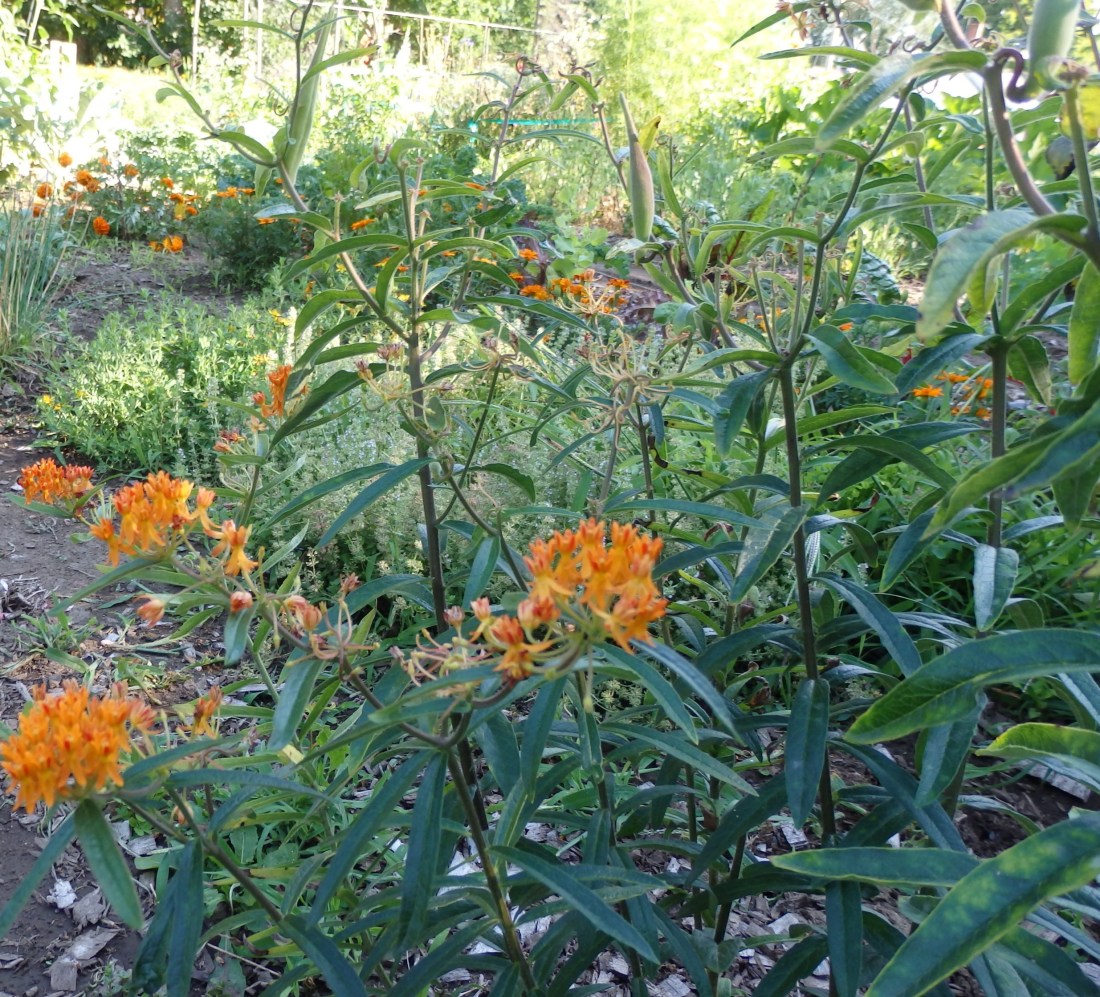
Photo at top: Butterfly weed at my garden at Elmwood Community Garden, Barre, VT
The monarch alighted on the pale green milkweed growing amongst patches of purple and orange. All along her journey north she had not seen this particular flower before. Mead’s milkweed, where the monarch stopped, is a threatened species. As was stated in the previous article, endangered plants are generally less well known than animals, but growing them in gardens, so long as legally purchased, can be a major benefit to both the plants and the animals that depend on them. This year’s gardening article will pair with the last one in that it will feature a few endangered plants, but will also bring back some old favorites.
Flowers:
Mead’s Milkweed (Asclepias meadii) It is listed as threatened on the U.S. Endangered Species List. As a member of the milkweed family, it is the only type of flower monarch butterflies will lay their eggs on. It has pale green flowers, and was once widespread across the Midwest, but has been decimated by agriculture, urbanization, herbicides, and invasive species.
Butterfly weed (Asclepias tuberosa) This is not an endangered species, but is a popular flower with many species of butterflies. As member of the milkweed family, it is also a host for monarchs. It grows 1-2 1/2 feet, produces orange flowers from mid summer to early fall and is native to New Hampshire to Florida west to Minnesota and south to Arizona and Mexico.
Bee balm (Monarda didyma) Also not endangered, but another old favorite. It produces beautiful red flowers in July and, as its name implies, it is a favorite of bees. It grow 2-5 feet and is native to Maine west to Michigan and Ohio and south to northern Georgia.
Smooth coneflower (Echinacea laevigato) The smooth coneflower is a close relative of the more common and better known purple coneflower (Echinacea purpurea). The smooth coneflower is listed as threatened on the U.S. Endangered Species List. It is native to the Midwest, but fire suppression and agriculture have destroyed much of its habitat.
Western lily (Lillium occidentale) It is listed as endangered on the U.S. Endangered Species list. It is native to southern Oregon and northern California, but coastal development, cranberry farming, poaching, and draining wetlands, have also reduced much of its habitat. It is a popular flower with hummingbirds and produces more nectar than any other U. S. lily.
Sundial Lupine (Lupinus perennis) It produces purple-blue flowers in late spring and is the only host plant for the endangered Karner blue butterfly. It grows 8 inches to two feet, requires sun dry to average soil and is native to Maine south to Florida and west to Minnesota and Indiana.
Shrubs:
Serviceberry (Amelanchier canadensis) It grows 8-15 feet tall and produces white flowers and red berries which are also edible for people. It requires sun to part shade in average soils. It is native to Quebec and Maine to Minnesota, New York, Michigan, Iowa, and south to North Carolina. The western serviceberry (Amelanchier alnifolia) also produces fruit in early summer which is edible for both birds and people and is native to western Minnesota, Colorado, and northern California.
Hazelnut (Corylus americana) This shrub grows about ten feet high and produces flowers in early spring. It requires sun to part shade and is native to Maine west to Saskatchewan south to Georgia, Louisiana, and Oklahoma.
Raspberry (Rubus odoratus) It flowers in summer and is good for birds. It is native to Maine west to Michigan and south to North Carolina and Tennessee.
Blueberry (Vaccinium carymbusum and V. angusifolium) V. carymbusum is the high bush blueberry and V. angusifolium is the lowbush blueberry which only gets 12 inches high. They flower in spring and fruit in summer and are one of the best shrubs for wildlife. They require sun to part sun. Lowbush needs dry soil, while highbush needs moist soil. They are native to Newfoundland west to Illinois and Michigan and south to North Carolina.
Trees:
American Holly (Ilex opaca) This is a tall tree which can reach forty feet, so it is not ideal for a smaller space, but it is good for birds in winter and adds a little green to the winter landscape. It need sun to part shade and is native to Maine south to Maryland and Virginia and west to Texas and Kentucky.
Pygmy fringe tree (Chionanthus pygmaes) It is listed as endangered on the U.S. Endangered Species List. It is smaller than its close relative the white fringe tree (Chionanthus virgenicus), which grows about 25-30 feet tall. The white fringe tree is not listed as endangered, however, as part of the ash family, both are susceptible to the emerald ash borer, an invasive pest from Asia. (For more on the emerald ash borer, see my previous article on this subject October 2018).
Native plants provide better habitat and more food for butterflies, bees, and birds than do introduced ones. In addition, native plants add food and color for people as well. If a few endangered plants can be added in that is an extra benefit. If you are considering any of the plants mentioned above, be sure they are native to your area and that they have been purchased from a reputable business, as poaching is also a problem with some endangered plants, particularly orchids and cacti. A few good resources are Donald J. Leopold’s Native Plants of the Northeast and the http://www.nationalwildlifefederation.org. At the National Wildlife Federation website under native plant finder, it is possible to plug in your zip code, and the site will bring up all plants native to your area. Happy Spring!
 The Nature Journal